
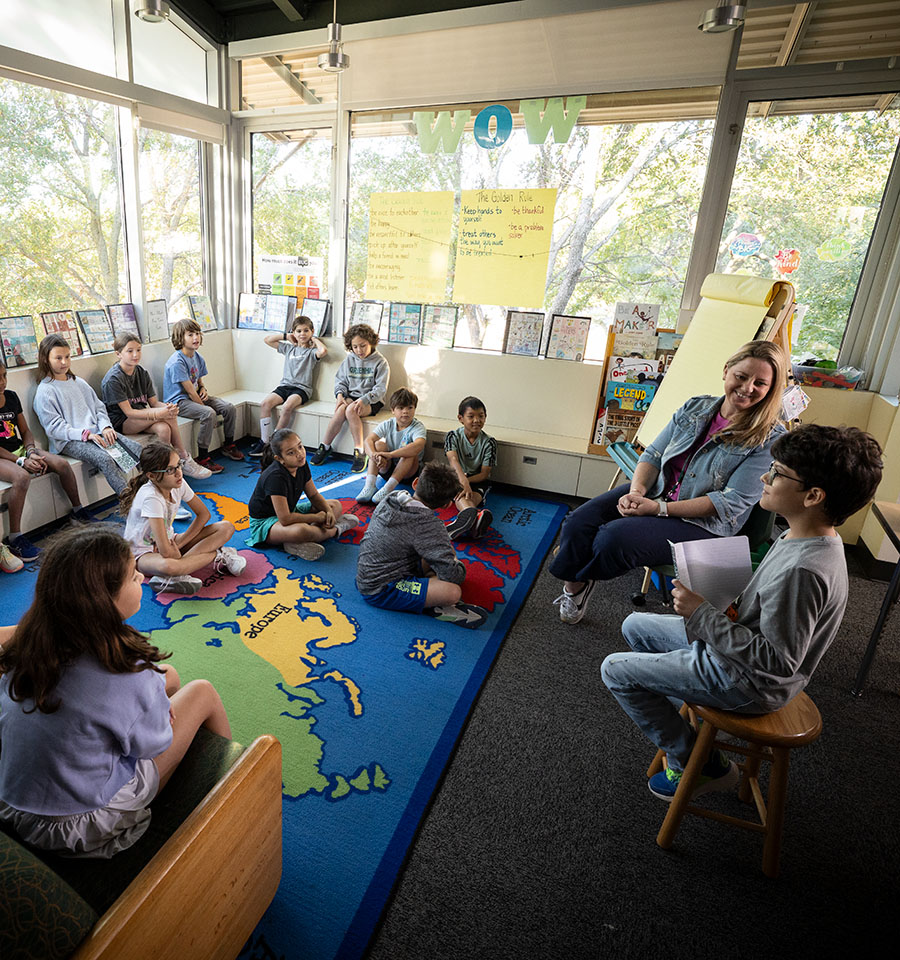
Evergreen Spotlight: Shining STARS – Students Explore Scientific ResearchOver the summer, four Greenhill seniors participated in the Science Teacher Access to Resources summer research program. The following story was featured in the November issue of The Evergreen. |
|
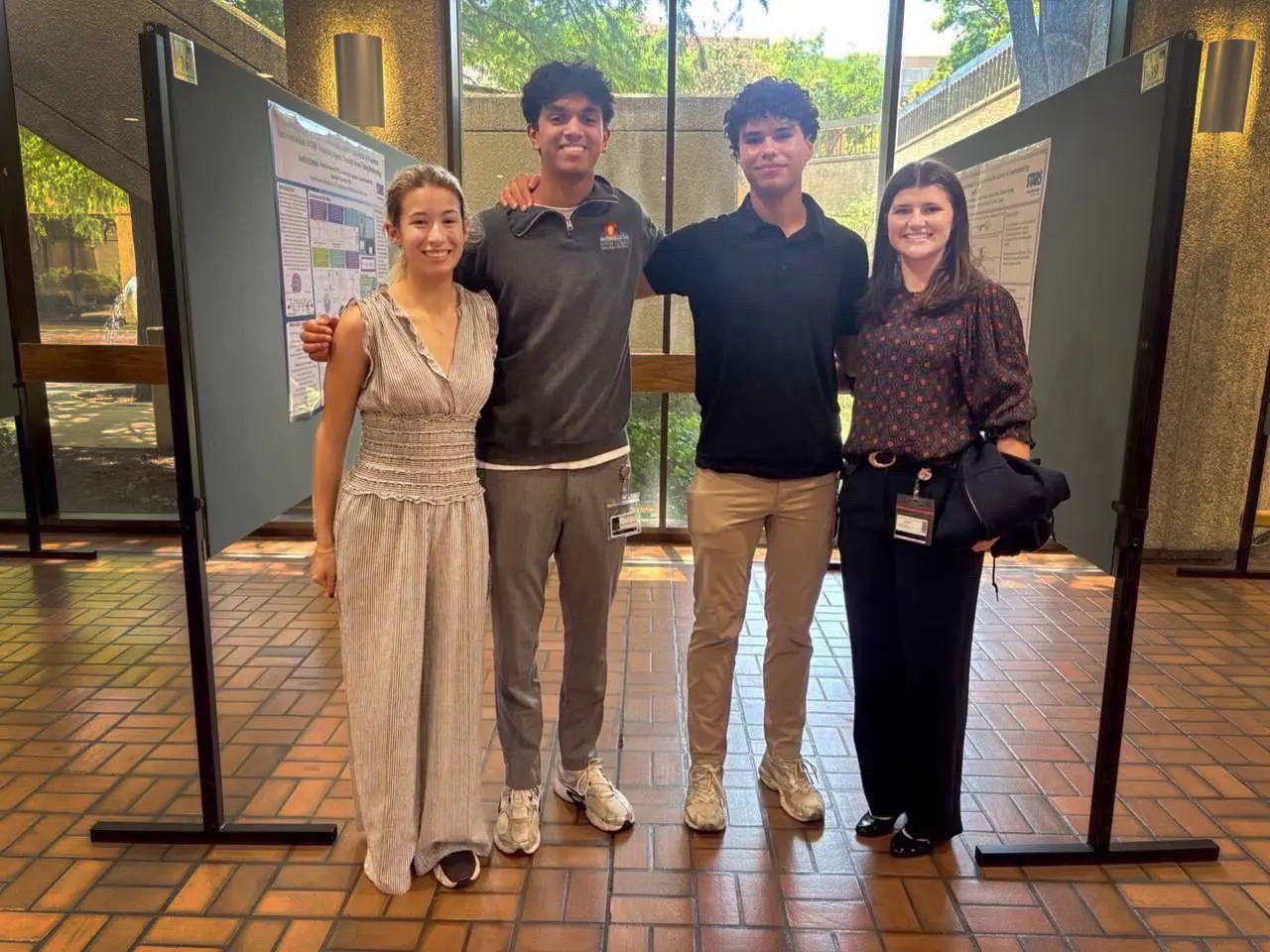 From left, seniors Ronni Phillips, Niseem Bhattacharya, Ibrahim Abdelfattah, and Charlotte Faems present their summer research findings at UT Southwestern. Photo courtesy of Charlotte Faems
By: Aanya Bhoria, Ela Battikhi
Most members of the Class of 2027 spent their summer relaxing by a pool or hanging out with friends. For four seniors, though, the time off was characterized by long commutes, extensive hours in the lab, and scientific discovery as part of the UT Southwestern’s prestigious STARS program.
The selective eight-week paid STARS research program – formally the Science Teacher Access to Resources at Southwestern program – allows students to conduct real-world research in labs.
With Greenhill’s long-term STARS partnership, students can be exposed to an authentic research experience they might not receive in a traditional classroom, according to Upper School science teacher Treavor Kendall.
“Research in the wild and in real life, if you will, is a little bit more open-ended, a little more messy,” Kendall said. “And so, it really gives students exposure to that, so they can understand if it's something [they would] like to continue to do.”
Senior Charlotte Faems first heard of STARS her freshman year through a presentation done by a former program participant during an Upper School assembly.
“I remember everyone in my advisory was like, ‘This is so annoying and boring,’ and I didn't want to say anything, but I was actually interested, even though I didn't know what was going on,” Faems said.
The application process for this past summer’s STARS researchers began in the fall of their junior year. Applicants submitted a resume and a one-page written work, along with a recommended two-minute video essay.
Senior Ibrahim Abdelfattah found the video essay beneficial to his application.
“I think that was somewhere where I shined because I made a video kind of just explaining a day in my life and walking through what a typical day looks like,” Abdelfattah said.
After students complete their STARS applications, the Greenhill science faculty determines which applicants will progress to UT Southwestern’s interview process.
Of the 20-40 Greenhill students who typically apply to the program, around five to eight are recommended by faculty to continue in the process. From the interview, STARS accepts around two or three students on average into the program each year.
“It's a little scary when you first get into [the interview], and they aren't just asking you ‘what's your name’ or ‘what school do you go to,’ kind of questions,” Abdelfattah said. “They're asking very thoughtful, open questions. What they're looking for is ‘can you think on your feet?’”
Students generally know whether they’ve been selected for the STARS program by early April. They are then matched with a UT Southwestern lab and mentor based on the fields of study they listed when applying.
Faems advises potential applicants to reflect on their interests before committing to STARS.
"I think you definitely should do it, but you have to be dedicated, and you have to be interested," Faems said.
Ronni Phillips
Senior Ronni Phillips was selected for the program and began most of her days at 6 a.m., driving 50 minutes from her house to the UT Southwestern Medical Center in downtown Dallas. Each morning, she set a goal: conduct two five-hour-long experiments before leaving the center at 6 p.m.
Phillips worked in a chemistry lab and focused on developing a test to identify whether new drugs could cause dangerous interactions with other medications. To do so, she studied seven liver enzymes called cytochrome P450.
She conducted tests using a laboratory procedure called an assay and programmed a mass spectrometer, an instrument that can measure specific chemicals in a sample.
“It was a lot of work,” Phillips said. “I had a Close Friends Instagram story, and I knew that my hours were not normal because there were people being like, ‘Ronni, you're doing so much work.’”
Her most significant research finding came unintentionally. When testing her method on a drug that had advanced in testing, her results suggested that the drug could interfere with the enzymes, potentially affecting how the body processes other medications.
After repeating the experiment twice, Phillips brought her findings to her principal investigator. Her work eventually ended up impacting an ongoing investigation and resulted in parts of her work being censored.
“That became a big part of my project,” Phillips said. “Eventually, I was not allowed to include the name of the drug because of that.”
Niseem Bhattacharya
Senior Niseem Bhattacharya had a unique application process. Bhattacharya participated in the Dallas Regional Science Fair in February 2026, where his project caught the attention of a judge, who happened to be a former STARS team member.
The judge put him directly on a list for the final interview process at STARS, and Bhattacharya received his acceptance shortly afterward.
Unlike many peers from Greenhill, Bhattacharya worked primarily on a computer in a computational biology lab. Here, he used an AI tool called AlphaFold to design protein binders that would attach to spinal projection neurons with the goal of pain relief.
Bhattacharya started off with more experience in coding than biology. Because of this, he appreciated the way he collaborated with his primary investigator.
“I was meeting with him basically every day,” Bhattacharya said. “He was super involved, and he was really nice because he knows that I'm not very strong in the biology side of things, so he was very lenient. But he expected me to do good with the coding aspect of it.”
Bhattacharya found that the most difficult part of his research was ensuring that the protein binders would actually function biologically. For several weeks, his designs failed computational tests, forcing him to repeatedly adjust his parameters and start again.
“The most rewarding part of the process was that with like two weeks left, I finally got accepted binders,” Bhattacharya said.
Charlotte Faems
Faems conducted research in a cardiology lab, studying atrial fibrillation by examining how genes regulate atrial homeostasis.
She worked alongside another STARS researcher in the same lab.
“We kind of worked on a very similar project,” Faems said.
Later, Faems and the other student-researcher organized experiments “to create virus to inject the mice,” she said. Throughout the program, Faems worked directly with mice to study their heart activity. Each morning, she and her lab partner checked on the mice, monitored newborn pups and weighed them before bringing selected mice into the laboratory for electrocardiograms.
“We did a lot of EKGs, so we would anesthetize the mice and then hook them up to leads,” Faems said.
These EKGs allowed the researchers to record electrical activity in the mice’s hearts. Faems then worked with plasmid DNA, cutting and inserting DNA sequences, and using polymerase chain reaction as a part of the lab’s experiment.
Beyond the lab, this experience reinforced Faems’ interest in pursuing veterinary medicine.
“Within the past few years, I realized that I want to be a vet, and I think this kind of reinforced it,” Faems said.
Ibrahim Abdelfattah
Abdelfattah worked in a pharmacology lab specializing in toxoplasma. His research involved studying proteins and attempting to produce them by inserting a gene into a DNA vector through a process called Gibson assembly.
Abdelfattah’s work consisted of preparing DNA samples and sending them for sequencing to check whether the DNA was formed correctly.
He also met with his lab mentor to review his progress and determine whether to move forward or repeat an experiment.
The specialized nature of his research required him to work independently and consult published papers to better understand his experiments, according to Abdelfattah.
“If something goes wrong, you actually have to read,” Abdelfattah said. “Because I was researching something that I think I'm one of three people in the world to know about, I can't just look it up on ChatGPT or Safari.”
The program also strengthened his interest in pursuing biology and continuing protein research in college.
“It solidified the fact that I want to major in biology, but more than that, it solidified the fact that I want to do undergraduate research,” Abdelfattah said.
Beyond the Lab
While each of the four seniors pursued different research topics, the STARS program offered an opportunity to gain experience beyond a traditional classroom setting and develop understanding of scientific research.
Kendall says the program allows students to develop greater independence, strengthen their ability to ask questions and determine whether they want to continue pursuing research. Students tend to become increasingly enthusiastic as they immerse themselves in research, according to Kendall.
“They were kind of excited before, and then when I saw them in the program and saw them at the seminars, it seemed like that enthusiasm was heightened,” Kendall said.
Beyond developing scientific skills, this experience challenged students to navigate unfamiliar concepts and become comfortable with the uncertainty that comes with research.
“I think the main goal of the program is not to expose you to research,” Faems said. “It's to expose you to things that you don't understand, and to kind of be okay with that.”


