
Alumni Spotlight: Alexander "Alex" Gupta '09
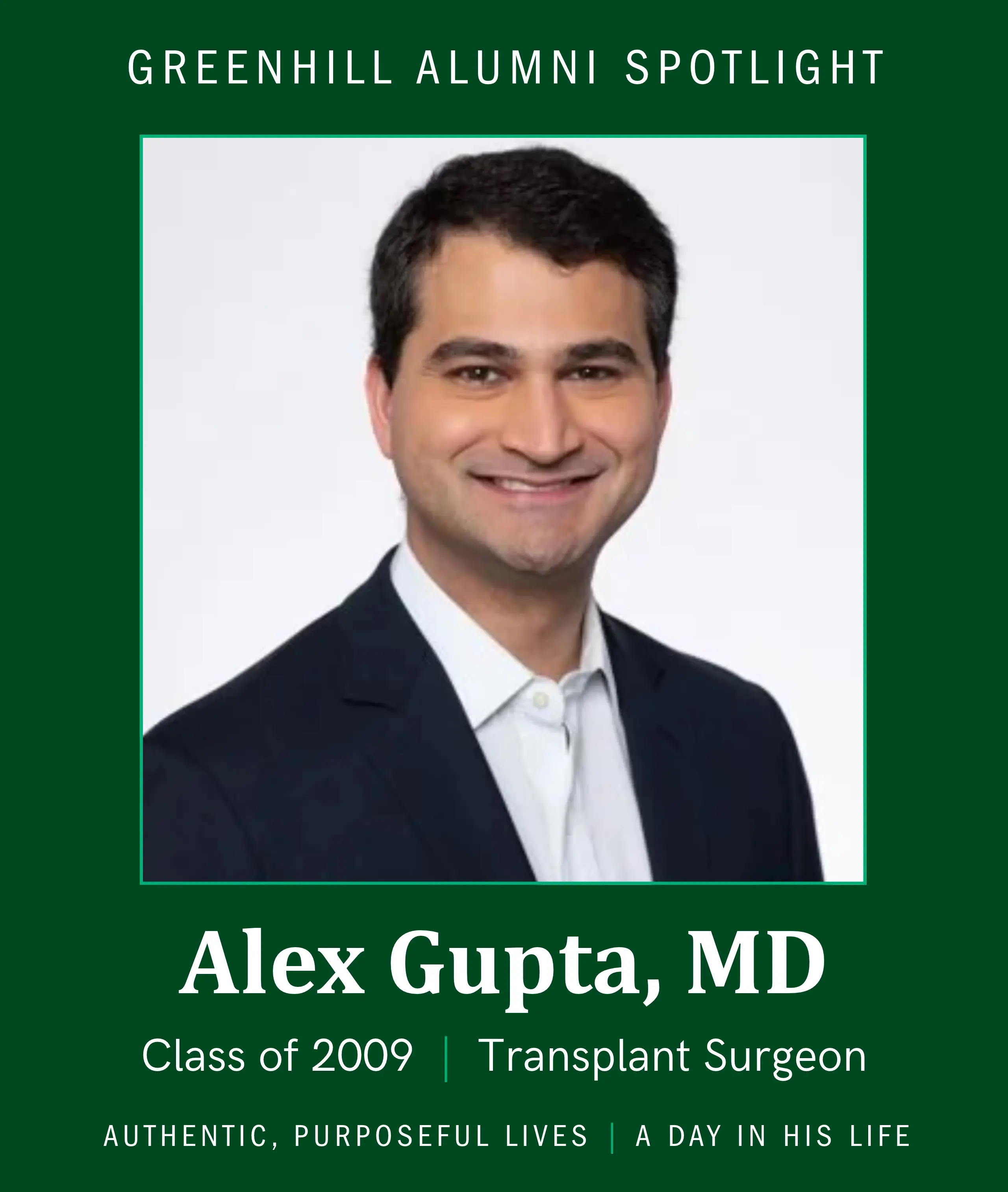
Alexander "Alex" Gupta graduated from Greenhill School in 2009. He is now a transplant surgeon at the University of Washington. We caught up with him recently to learn more about what he does.
|
Alexander "Alex" Gupta, MD, graduated from Greenhill School and went on to Southern Methodist University, where he studied electrical and biomedical engineering, before attending medical school at the University of Texas Medical Branch. He completed his general surgery residency and abdominal transplant surgery fellowship at the University of California, San Francisco (UCSF), including an NIH-funded immunology research fellowship. Today, he is a faculty member at the University of Washington, where he transplants livers, kidneys, and pancreases, and where his research builds the infrastructure connecting scientists to donated human organs and tissues that would otherwise go unused. |
 |
No Average Tuesday
Ask Gupta what a typical day looks like, and the answer is that there isn't one.
"There isn't really an average Tuesday. Donor organs don't arrive on a schedule, so a chunk of the job is unplannable more than 12 hours ahead. Most days include surgery of some sort, but the range is wide: a kidney transplant takes about two hours, while a redo liver transplant – someone receiving a liver transplant for a second time – can take 10 hours or more. Some days the recipient is a child. And then there are living donor operations, where we remove a kidney or part of a liver from a healthy person so that it can be given to someone else. The donor gains nothing medically from what we're doing; they're doing it for someone else's well-being – sometimes a family member, and sometimes a stranger they will never meet.
When I'm not operating, I'm in clinic meeting people who are hoping to get on the waitlist or who have just had their transplant, or on the phone evaluating an organ that has just become available and deciding whether it's appropriate for a patient. And before any transplant can happen, someone has to travel to the donor hospital and procure the organs. It's quiet work, and everything downstream depends on it being done well."
The Cost of a Long Runway
Becoming a transplant surgeon took Gupta more than a decade after college — three years of undergraduate study, then fourteen more years of training. He's candid about what that stretch cost him, and about the mental shift it eventually required.
"I finished college in three years because I was in a hurry, then I spent 14 more in training: four years of medical school, eight years of surgical residency including years in a research lab, and then a two-year transplant surgery fellowship. For most of that stretch, friends from Greenhill were getting promoted, buying houses, and having children – building adult lives – while I was working toward a job that was still years away.
The true failure was treating my friends' timeline as the real one and mine as delayed, which turned a decade of genuinely extraordinary work into a waiting game. Framed differently, I wasn't just waiting around – I was operating on people, or I was in a lab learning things nobody had discovered before. The years you spend laying the framework aren't a down payment on your career – they are a part of the career. I wasn't ever falling behind. My friends and I were running different races.
So, the advice I'd give a student weighing this path is not to choose it for the destination, because the destination is far away and can feel out of reach early on. Choose it if the daily work is something you want to be doing anyway. If it is, then the timeline stops mattering; if it isn't, then nothing waiting at the end will carry you through the hard times."
"I wasn't ever falling behind. My friends and I were running different races."
Unlearning the Right Answer
School trains students to look for a correct solution. Surgery, Gupta says, rarely offers one.
"What I had to unlearn was my appetite for right answers. In school, problems have solutions, and somewhere in the teacher's desk is an answer key. In transplant surgery, you're rarely choosing between right and wrong – you're weighing two kinds of risk against one another. A version of this happens almost daily: a patient on the waiting list is offered a kidney from an older donor. If you accept it, the patient may get fewer good years out of that organ than they would from an organ from a younger donor, but if you decline it, a better offer may never come. And there often isn't a long conversation about it – you call the patient, sometimes at 3 AM, and you can only share general information, and most of the judgment is yours. The skill isn't certainty. It's making a decision you can defend and changing your mind the moment the facts change."
"The skill isn't certainty. It's making a decision you can defend and changing your mind the moment the facts change."
Building the Bridge Between Donors and Discovery
Beyond the operating room, Gupta is focused on a quieter, systems-level problem: thousands of donated organs go untransplanted every year, and most are never used for research either, simply because the logistics of connecting a donor to a scientist are too hard.
"Every year, thousands of donated organs can't be transplanted because the match isn't right or the organ wasn't quite healthy enough. These organs are perfect for research, except most of them get discarded because the logistics of connecting a donor in one place to a scientist in another are hard. This undermines the intent of the donor, who wished to further science, and hampers the advancement of our understanding of human biology.
I previously helped build the infrastructure to narrow this gap so that a scientist can submit a request for human organs or tissues, and the machinery behind the scenes handles the contracts, the ethics framework, the billing, and the recovery, all to deliver organs to the lab within hours. Before, more than 70 laboratories at my institution wanted human tissues and only four had reliable access. In five years, the number of participating labs went from 8 to 42, and the science it enabled has brought in more than $28 million in research funding. My current undertaking is to build the second version of it at the University of Washington with the goal being a West Coast consortium – so a scientist in Seattle can study an organ recovered in San Francisco, and the other way around.
Three reasons this matters. First, mice are not people. An enormous amount of biology has been worked out in rodents, but may not translate into humans. The NIH and FDA are now actively pushing research toward human-based models, which you can't do without human tissue. Second, we can now study organs while they're alive. Modern perfusion devices let us keep a human organ functioning outside the body for hours or days, which enables experiments that were previously impossible. One line of work we're pursuing is editing a donor organ's genes so the recipient's immune system doesn't attack it, which could mean not needing immune-suppressing drugs for the rest of their life. Third, you can't predict what people will find. When collaboration went from four labs to 42, the discoveries came from directions nobody at the center would have guessed – the genetics of kidney function, how the human intestine is organized, how ovaries age. When you build infrastructure, innumerable projects can use it."
Science Kid, Humanities Kid – Why Not Both
Asked what he'd tell a Greenhill student who feels pressure to pick a lane between science and the humanities, Gupta points back to his own education.
"A fundamental strength of Greenhill is that you don't have to make this choice. You take the hard sciences and the hard humanities, and the expectation is that you'll be excellent at both.
Doing surgery is a lot of science, but it's a lot of language too. It's explaining to a family, in the middle of the night, what's happening to someone they love; it's writing a persuasive grant proposal to secure funding; it's convincing administrators to support building infrastructure that advances science. Science may be the underpinning of what I do, but the things I learned in Greenhill's English and history classes are what let me do anything with it. Even the Spanish – I use it almost daily, and speaking with a patient directly connects in a way that's hard to reach through a video interpreter on an iPad.
So, take the hardest science you can, and take the writing and the language just as seriously. You'll use both."


